Posted on Oct 30, 2026 in India Discovery,Student Speak
1 Comment
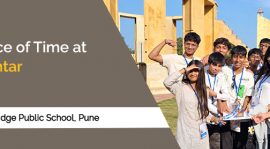
Time has always been an important part of human life. Ancient civilisations, including the Egyptians, developed sundials to measure time using the position of the Sun and the movement of shadows. In the 18th century, the Kachwaha ruler Sawai Jai Singh II established five astronomical observatories in Delhi, Jaipur, Mathura, Ujjain, and Varanasi. During our visit to Jantar Mantar in Jaipur, we were amazed to see how these enormous stone instruments were used to study astronomy without modern technology.
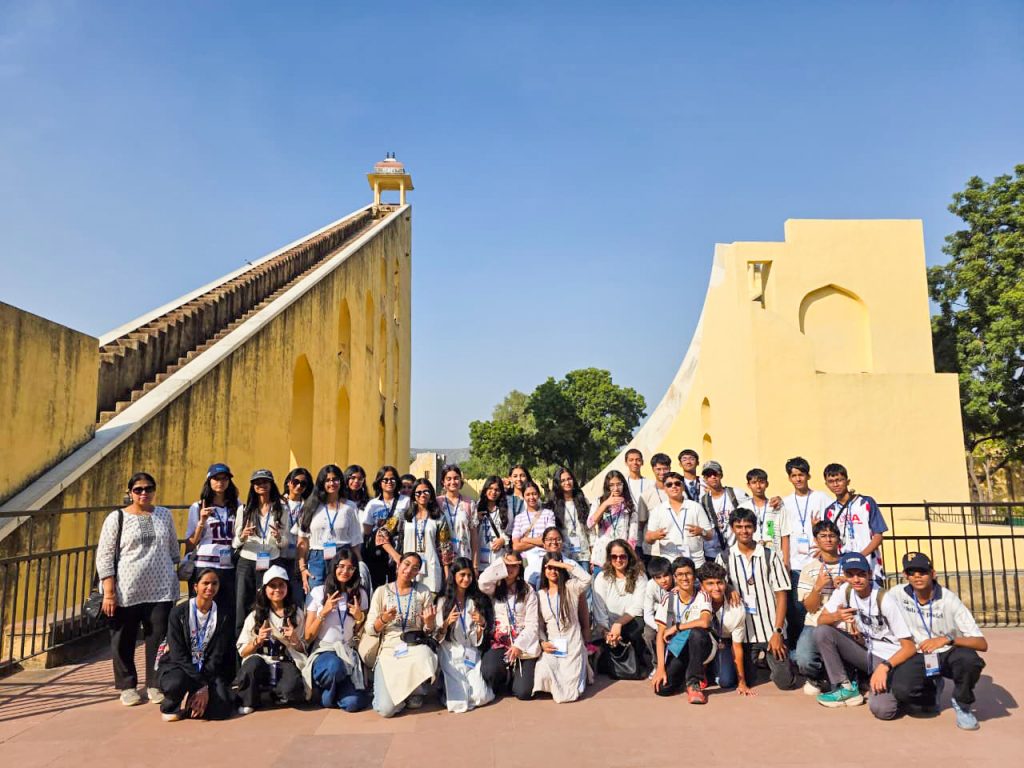
One of the most fascinating instruments was the Vrihat Samrat Yantra, the world’s largest stone sundial. Standing approximately 27 metres tall, it can measure local solar time with an accuracy of about two seconds. Our guide explained how its triangular structure, called a gnomon, casts a shadow on marked scales. As the Sun appears to move across the sky, the shadow shifts, indicating the time. We were surprised to learn that Jaipur’s local solar time differs from Indian Standard Time because of its geographical longitude. Watching these instruments helped us understand how shadows could be used for accurate scientific measurements.
We also explored the Jai Prakash Yantra, consisting of two hemispherical bowls used to determine celestial positions. The Rashivalaya Yantras were designed to study the twelve zodiac signs, while the Yantra Raj helped astronomers calculate the positions of celestial bodies. Another interesting instrument was the Rama Yantra, which measures the altitude and direction of celestial objects. Exploring these remarkable structures gave us a deeper appreciation of the scientific knowledge of earlier generations. Our visit showed us how mathematics, astronomy, and careful observation worked together, making Jantar Mantar an unforgettable educational experience.
For queries call +91-11-48885800 or visit EdTerra Browse Journeys page to know more about the programs for school students. Visit our FB page by clicking HERE. Also, check our podcast page by clicking HERE.
Imagine a 4-day trip...

Block printing is a...
Time has always been...
Could you explore an...
Our journey to TERI’s...

Our journey to Supi...

Mussoorie, popularly known as...
Jim Corbett National Park...
Jim Corbett National Park,...
We believe that only...

See What Our Edventurers Experience!